Signages in Dubai: Why Material Choice Wins
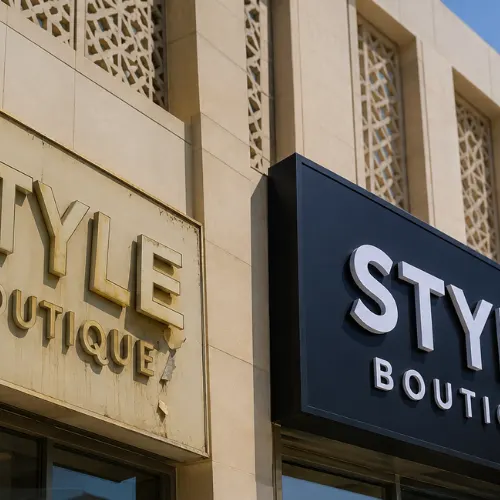
Summer in Dubai does not politely test a sign. It attacks it. Surface temperatures on a south-facing shopfront panel climb far above whatever the weather app is showing, and the material either holds or it starts to go. Yellowing. Warping. Adhesive letting go quietly until one letter tilts. Most of the time the failure has nothing to do with the design. It traces back to a material decision made months earlier, often to save a little money. So here is what actually matters when you are specifying signages in Dubai, and why the sample board matters more than the mockup.
What Heat Actually Does to a Sign?
Three things happen, and they happen at different speeds.
UV exposure breaks down pigment and plastic. Colour shifts first. Reds and blues fade before anything structural gives way, which is why a sign can look tired long before it looks broken.
Thermal cycling is the sneaky one. Panels expand through the day and contract at night, every night, all year. Fixings that were snug in November work loose by August. Different materials expand at different rates, so a mixed build with poor allowance for movement will pull itself apart at the joints.
Then there is heat soaking inside illuminated units. A sealed light box with weak ventilation cooks its own components. LEDs lose brightness faster at sustained high junction temperatures, which is documented in the US Department of Energy Solid-State Lighting programme, LED lifetime and thermal management guidance.
Material by Material: What Holds Up in Signages in Dubai
Acrylic
Acrylic is the workhorse for backlit and light-box faces because nothing diffuses light as evenly at that price. But cast acrylic and extruded acrylic are not the same product. Cast holds up better under sustained heat and is less prone to distortion. Either way, ask whether the sheet is UV-stabilised. That single specification is the difference between a face that reads well after four summers and one that goes milky.
Acrylic is also better for vibrant colours and light-box effects than metal will ever be, which is why it keeps its place in the mix.
Stainless Steel
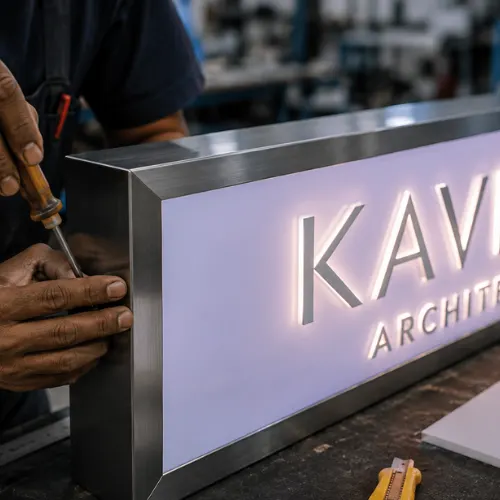
For high-impact building signage, stainless is the stronger option. It takes wind loading, it takes impact, and it does not care about UV at all. The catch is grade and finish. Coastal humidity and airborne salt near the Gulf will find any weak grade quickly, and a brushed finish shows water staining sooner than people expect.
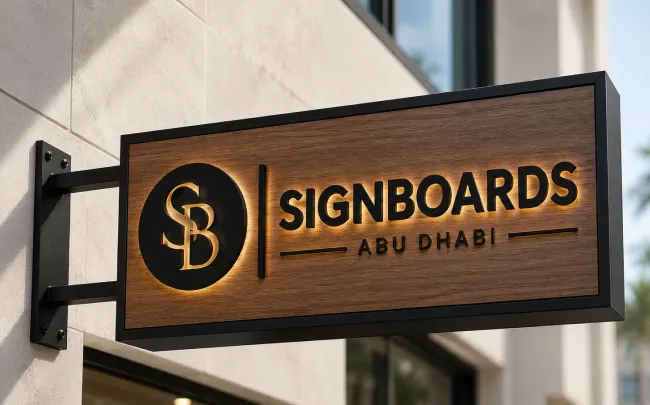
A common practical answer for the UAE is a hybrid: a stainless steel frame carrying the structure, with a UV-protected acrylic face carrying the light and colour. Strength where it is needed, brightness where it shows.
Aluminium and Composite Panels
Aluminium composite is light, easy to fabricate, and widely used for large flat facades and hoardings. The failure mode to watch is delamination, where the core separates from the skin after long heat exposure. Panel thickness and core quality decide that outcome more than the printed finish does.
Vinyl, Print, and Coatings
The graphic layer is usually the shortest-lived part of any sign. Solvent and eco-solvent prints without a laminate will fade noticeably within a season on a west-facing wall. A UV laminate is not an upgrade in this climate. It is the baseline
Where LED Displays Sit in This
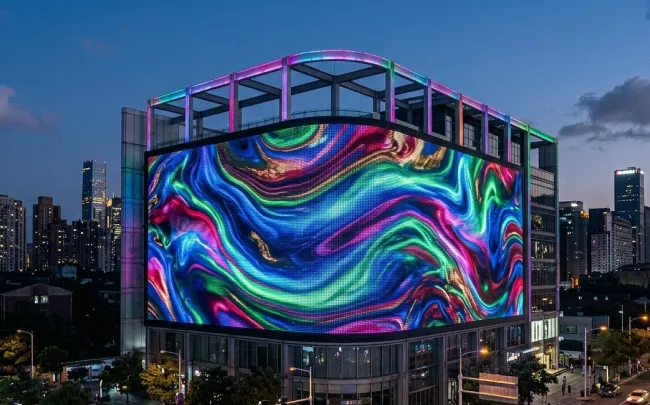
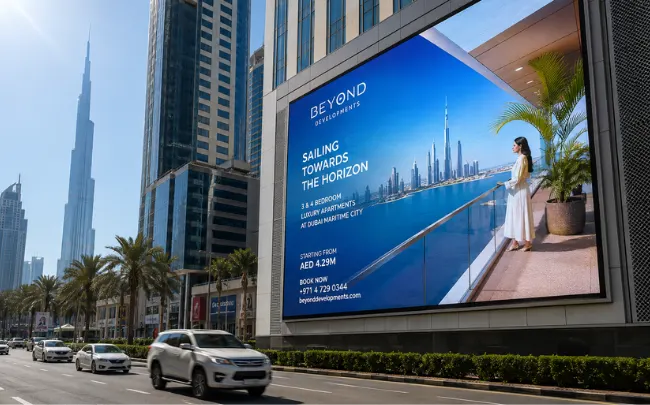
Digital changes the question. With an LED display supplier you are no longer asking whether a face fades. You are asking whether the cabinet is rated for ambient temperature, whether the IP rating suits direct exposure, and whether brightness is high enough that the content does not wash out at noon.
Outdoor LED screens built for this region use industrial-grade components and high-nit brightness precisely so the message stays readable in direct sunlight and the unit does not overheat in July. Pixel pitch is a separate conversation, driven by viewing distance rather than weather, but the thermal specification is the one that determines how many years you get.
Questions Worth Asking Before You Sign Anything
A capable signboard company in UAE should be able to answer these without hesitating:
- Is the acrylic UV-stabilised, and is it cast or extruded?
- What grade of stainless, and what finish?
- How is the illuminated unit ventilated?
- What allowance has been made for thermal expansion at the fixings?
- What does the warranty actually cover, and for how long?
Also check that the signage company handles municipality approval, because signages in Dubai are subject to rules on size, illumination, and structural safety that differ from the other emirates.
Final Thoughts
Material choice is not a detail you delegate. It is the decision that quietly sets how long everything else lasts. A sign specified properly for this climate looks the same in year four as it did in week one, and that consistency is what your brand is really buying.
So before you approve the next quote, ask one thing: does this specification account for a Dubai summer, or does it just look right in the drawing?
FAQ
For pure structural life, stainless steel. For colour and light, UV-protected acrylic. Most good outdoor builds here use both together: steel for the frame and acrylic for the face.
Almost always the print layer or non-stabilised acrylic. Unlaminated vinyl in direct sun can lose its punch within a single season. It is a materials issue, not a design one.
Yes, if they are specified for it. Outdoor units built for this region use industrial-grade parts and high brightness so they neither wash out at midday nor cook themselves in July. Indoor-rated hardware pushed outside is where things go wrong.
Depends on what the sign has to do. Want a glowing, colour-rich face? Acrylic. Want a solid, premium 3D logo on a building? Stainless. Want both? That is the hybrid most fabricators recommend for the UAE.
A well-specified outdoor sign should hold its appearance for several years without visible fading or movement. Ask the fabricator what their warranty period is and what it actually covers, since coverage varies a lot between providers.